Product teams are organised to ship. That makes them good at improving the part of the product they own and bad at imagining a version that cuts across those boundaries.
In a finance app, one squad may own payments, another cards, another investing. Each can make sensible local decisions while the whole product becomes harder to understand.
The usual answer is to ask delivery teams to think further ahead. In practice, urgent work wins. I prefer to separate three kinds of responsibility without separating the people.
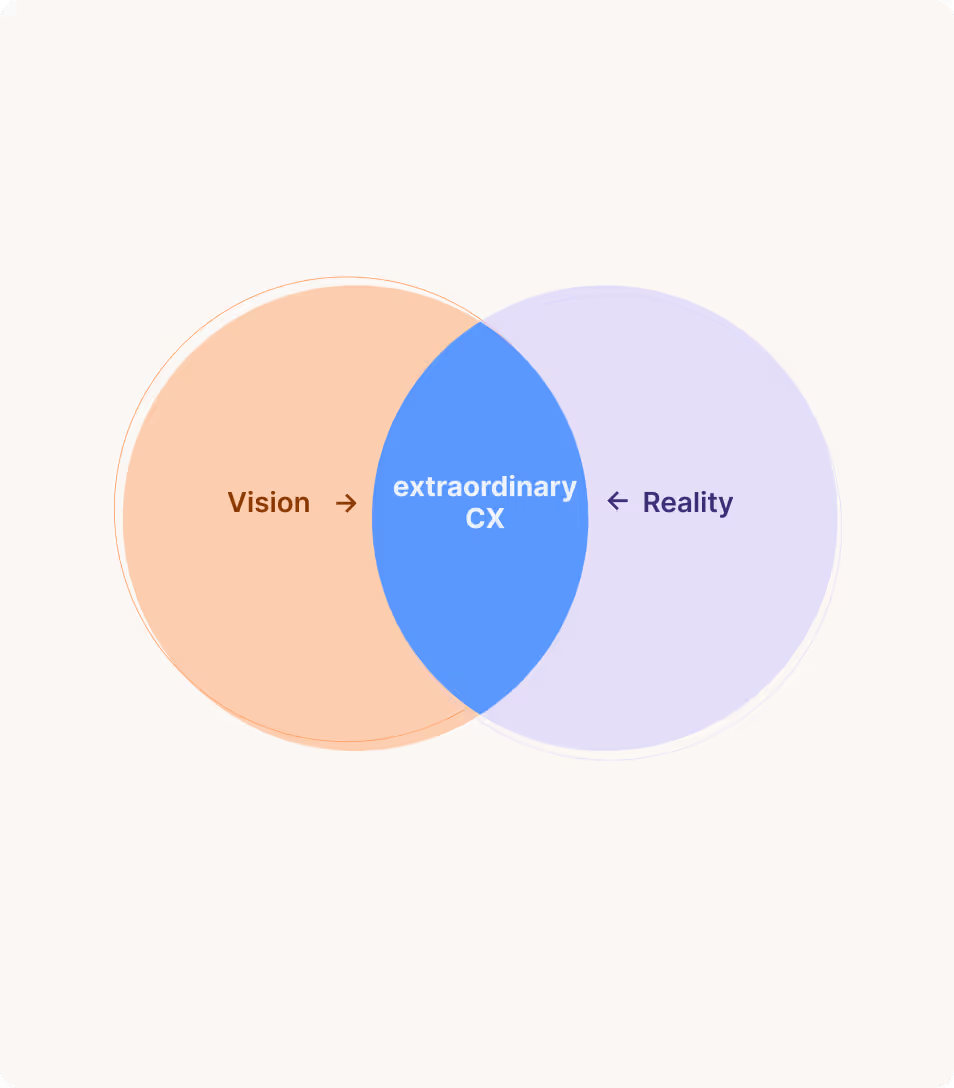
1. Vision
A small group describes the best coherent version of the product. It works beyond the current squad map and is allowed to challenge technical and commercial assumptions. Its job is direction, not a speculative redesign for the wall.
2. Bridge
Designers, product managers and engineers turn that direction into sequences the organisation can actually deliver. They expose dependencies, decide what can change now and protect the parts of the vision that matter most.
3. Reality
Product teams own the live system: customer problems, reliability, experiments and incremental progress. They also feed evidence back into the vision. Reality is not the team that executes someone else’s dream; it is the source of truth that keeps the dream honest.
The important boundary
These do not need to be three permanent departments. They are three modes of work with explicit owners, time and decision rights.
If vision has no bridge, it becomes theatre. If delivery has no vision, local improvements accumulate into a confusing product. If neither listens to reality, the company ships its own assumptions.
Decoupling helps when it creates focus without creating handovers. The goal is not more teams. It is to give long-term direction enough space to survive the next sprint.